If you’ve ever wondered how often should you change your oil, the honest answer is that there’s no single number that fits every car. Start with your owner’s manual and your vehicle’s oil-life monitor. Many modern vehicles running synthetic oil go roughly 5,000 to 10,000 miles between changes, while older vehicles or engines on conventional oil often need it sooner. If you drive in severe conditions, such as Houston heat, stop-and-go traffic, short trips, towing or dusty roads, you’ll usually want to follow your manufacturer’s “severe service” schedule instead.
Below, we break down what affects your interval, why so many Houston-area drivers fall into the severe category, and how to tell when your engine is ready for fresh oil.
Conventional, Synthetic Blend or Full Synthetic: What’s the Difference?
The type of oil your engine uses plays a big part in how long it lasts. Your owner’s manual lists the oil type and viscosity your engine was designed for, and that’s always the place to start.
- Conventional oil is refined from crude oil. It does the job in many older engines, but it generally breaks down faster under heat, so intervals tend to be shorter.
- Synthetic blend mixes conventional and synthetic base oils. It offers better protection than conventional oil without going all the way to full synthetic.
- Full synthetic is engineered to resist heat and breakdown. Many newer engines require it, and it’s the reason a longer synthetic oil change interval is possible on many modern vehicles.
A longer interval isn’t automatic just because you switched to synthetic, though. The manufacturer’s schedule still sets the limit, and your driving conditions can shorten it.
Severe Driving Conditions: Why Houston Driving Often Qualifies
Most owner’s manuals include two maintenance schedules: a “normal” one and a “severe service” one. Many drivers assume they fall under normal, but the list of severe driving conditions usually includes things that describe everyday life around Houston:
- Extended driving in high outside temperatures
- Frequent stop-and-go traffic, like a backed-up 59 or FM 1960 during rush hour
- Lots of short trips where the engine never fully warms up
- Extended idling, such as school pickup lines or drive-thrus
- Towing a trailer or boat, or carrying heavy loads
- Driving on dusty, gravel or unpaved roads
Heat and stop-and-go driving put extra stress on oil, and short trips can leave moisture and fuel residue in the crankcase. If several of these sound familiar, ask us whether your vehicle should be on the severe service schedule. For many local drivers, it’s the safer choice.
How Your Oil Life Monitor Works
Many newer vehicles have an oil life monitor that shows a percentage on the dash or tells you when service is due. Most of these systems don’t test the oil itself. Instead, they estimate oil life using data like engine temperature, engine revolutions, trip length and operating time.
That makes them a useful guide, and in many vehicles they already adjust for harder driving. A few tips for using one well:
- Plan your service when the monitor reaches the range your manual recommends, rather than waiting for 0%.
- Make sure the monitor gets reset after every oil change, or its readings won’t mean much.
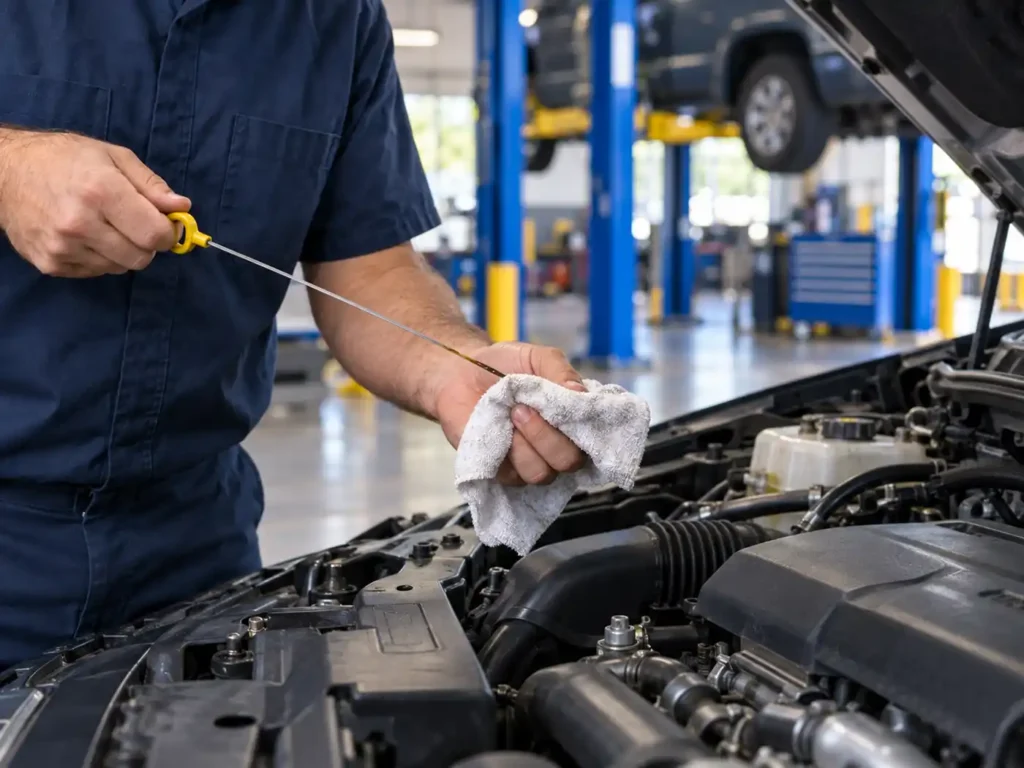
- Still check your oil level with the dipstick if your vehicle has one. A monitor tracks oil life, not how much oil is in the engine.
How Long Can You Go Without an Oil Change If You Don’t Drive Much?
Low mileage doesn’t mean you can skip service indefinitely. Oil ages even when the car sits, and short, infrequent trips are actually hard on it. That’s why most manufacturers set a time limit along with a mileage limit, commonly every 6 to 12 months, whichever comes first.
So if you’re asking how long can you go without an oil change on a car you only drive on weekends, the answer is usually found in that time-based limit in your owner’s manual. If you can’t remember your last oil change, it’s probably time.
How Often Should You Change Your Oil on an Older Engine?
Older engines deserve the same attention, if not more. Our advice is simple: never skip oil changes on an older engine. Regular service helps keep internal parts clean and protected as the miles add up.
You’ll see plenty of “high mileage” oil formulas on store shelves. In our view, they aren’t a must. What matters more is using quality products throughout your vehicle’s life. That’s why we use BG Products at our shop. If your vehicle is getting up there in miles, our high-mileage maintenance service can help you stay ahead of the items that tend to need attention as a vehicle ages.
Signs You’re Due and What Happens If You Wait Too Long
Your vehicle will often give you hints that it needs fresh oil. Watch for:
- An oil change reminder or low oil life reading on your dash
- An oil pressure warning light (stop driving and have it checked right away)
- Oil on the dipstick that looks dark and gritty or is below the minimum mark
- Louder engine noise, such as ticking or knocking
- A burning oil smell inside or around the vehicle
- You’ve passed the mileage or time limit in your owner’s manual
If you wait too long, oil loses its ability to lubricate and carry heat away. It can turn into thick sludge that restricts flow, which leads to faster wear on internal engine parts. In serious cases, that can mean costly engine damage. Staying on schedule is one of the simplest ways to protect your engine.
When you bring your vehicle in for an oil change in Humble, our ASE-certified technicians, with over 35 years of experience, follow your manufacturer’s recommendations. Every visit also includes a digital vehicle inspection with photos sent to your phone, so you can see what we see. We also serve drivers nearby with oil changes in Kingwood, Atascocita and Summerwood.
Frequently Asked Questions
Is the 3,000-mile oil change rule still true?
For many modern vehicles, no. Improved engines and oils mean many cars can go considerably longer between changes, especially on synthetic oil. That said, some older engines and severe driving conditions still call for shorter intervals. The right answer for your vehicle is in your owner’s manual, so check it or ask our team to look it up for you.
What is a typical synthetic oil change interval?
Many modern vehicles using full synthetic oil run roughly 5,000 to 10,000 miles between changes, but it varies by make, model and engine. Severe driving conditions, like Houston heat and stop-and-go traffic, can shorten that interval. Follow your owner’s manual and oil life monitor, and don’t go past the time limit your manufacturer sets.
Should I trust my oil life monitor?
For most vehicles, yes. An oil life monitor estimates oil condition based on how you drive, including engine temperature, trip length and operating time. It’s a helpful guide, but it doesn’t measure your oil level. Check the dipstick regularly if your vehicle has one, and make sure the monitor is reset after every oil change.
Do I need high mileage oil for an older car?
Not necessarily. In our experience, high mileage formulas aren’t a must. Using quality products throughout your vehicle’s life matters more, which is why we use BG Products. The most important thing for an older engine is to never skip oil changes and to use the oil type and viscosity listed in your owner’s manual.
Not sure when your next oil change is due? Our team at Beckwith’s Car Care is happy to check your manual and driving habits and set you up on the right schedule. We’re open Monday through Friday, 6 AM to 6 PM, and we offer a free shuttle service. Call us at 281-540-2000 or schedule your appointment online.